Professional Business Learning Performance Optimization Consulting
Take Your Business Training To New Heights Get StartedOptimize Your Business Training Today!
Get A Free Explorative Consultation

Don’t Settle For Less
Optimize Your Business Training and ROIs
Charge Forward
Business Training Roadmaps Built Exactly To Your Needs
This engagement introduces a structured, practical approach to improving how training is:
- Received
- Processed
- Retained
- Applied
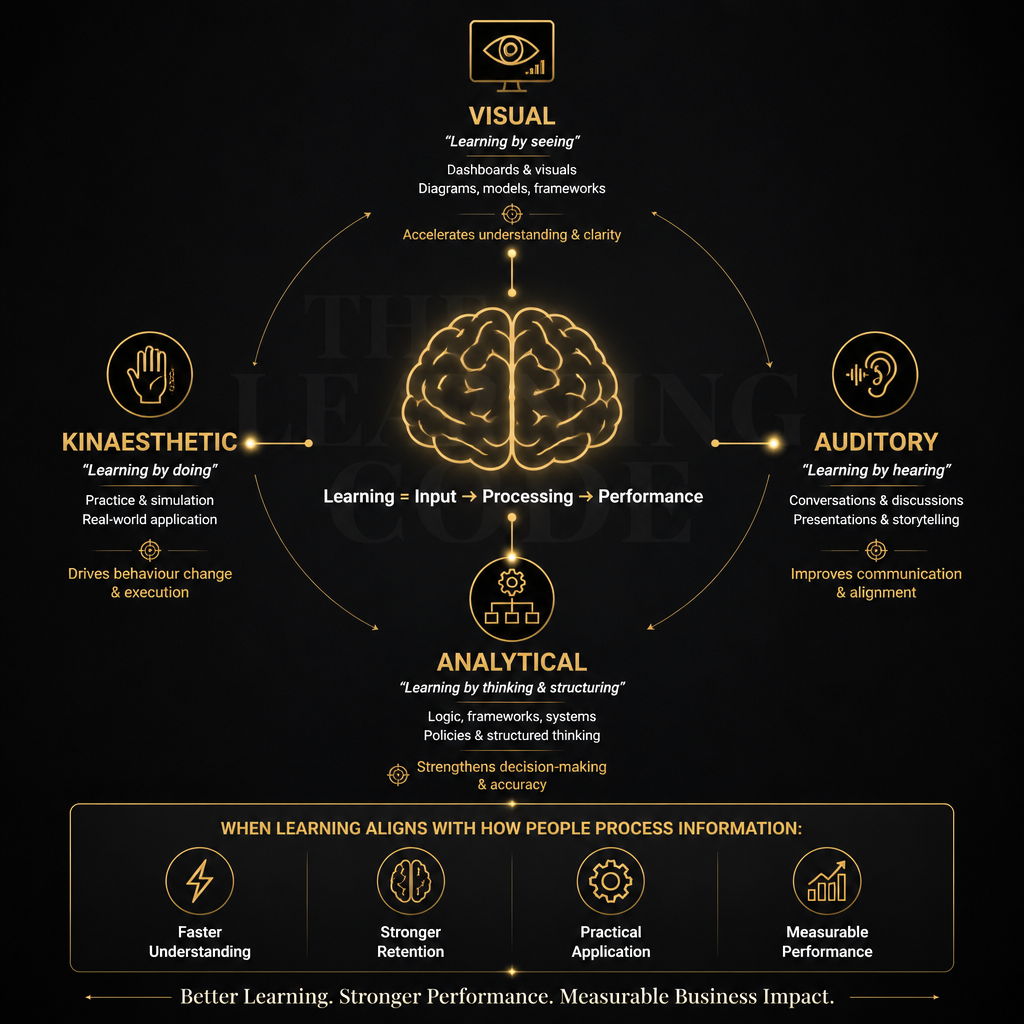
The framework is built around four dominant cognitive processing patterns:
- Visual – information processed through imagery and spatial understanding
- Auditory – learning through listening and verbal interaction
- Kinaesthetic – learning through experience and application
- Analytical (Auditory Digital) – structured, logic-based processing
Rather than treating these as theoretical concepts, the workshops translate them into practical business applications, including:
- Training design
- Communication strategies
- Meeting structures
- Onboarding processes
The outcome is reduced cognitive resistance and improved learning transfer.
From Our Founder
Who is Our Founder
Jeanine Slabbert is a Learning Performance Consultant specialising in cognitive psychology, behaviour change, and workplace learning effectiveness.
Her work focuses on enabling organisations to translate training into sustained behavioural change and measurable performance outcomes.
The Corporate Context – Why Cognitive Filters Matter in the Workplace
In the corporate environment, the challenge isn’t a lack of information—it is the effective transformation of that information into actionable knowledge and skills. Employees and leaders are constantly bombarded with data, emails, and procedural updates. The core bottleneck to performance is not effort, but cognitive processing.
As futurist John Naisbitt noted, “We are drowning in information but starved for knowledge.”
Cognitive science provides the framework for understanding this bottleneck. Every second, the human brain processes 11 million bits of information, yet the conscious mind (the part used in meetings, complex problem-solving, and learning new software) can only handle 40-50 bits per second (Norretranders, 1998; Miller, 1956).
The Implications for Corporate Trainers:
If the trainer’s message does not align with how the learner’s brain naturally filters information, the training is lost to “cognitive noise.” To improve retention, reduce onboarding time, and enhance skill acquisition, we must understand the filters—the Learning Modalities—that determine what information the brain deems important.
The Science of Workplace Learning Modalities
The brain processes information through five sensory modalities, but in a corporate context, four are dominant for learning and execution:
- Visual: Understanding through data visualization, reports, diagrams, and presentations.
- Auditory: Understanding through verbal instructions, meetings, and discussion.
- Kinaesthetic: Understanding through hands-on practice, role-playing, and “learning by doing.”
- Auditory Digital (Self-Talk): Understanding through logic, sequence, and internal dialogue. This is crucial for compliance, policy, and analytical thinking.
By identifying an employee’s Primary and Secondary processing style, trainers can tailor content delivery to bypass mental resistance and move information directly into long-term retention and application (Fleming & Mills, 1992).
The Business Case:
When training aligns with these cognitive filters, we move from passive information dissemination to active knowledge construction, leading to higher levels of competence and a better return on investment in training (Pashler et al., 2008).
Her work enables organisations to move from:
Training delivery → Behaviour change → Measurable results

Our Specialties
We Can Do It All. Get In Touch For a Free Consultation
Identify cognitive processing patterns within your teams
Identify “information loss” points in the current training
Redesign training content for improved retention and application
Apply techniques to reduce onboarding and re-training time
Train trainers in cognitive inclusive communication
Services
What We Can Do For You
This workshop is designed for:
- Learning & Development Specialists
- Internal Trainers & Facilitators
- Team Leaders & Supervisors
- HR Business Partner
to understand the psychological mechanics of how their staff learns. By utilizing the Information Input Assessment ©, participants will gain insight into their own cognitive biases and learn how to design training materials that resonate with every type of learner.
Inclusive cognitive communication
Learn to communicate across all learning styles
Increased training ROI
Increased information retention and application,
Identify the information loss factors
Where are your well intentioned training manuals losing your staff’s attention and focus
empowering staff
Assessment outcomes empower staff with an in depth knowledge of how their unique brains input information
Pricing
Service Packages
Learning Optimization Workshop (Half-Day)
Request A Quote- Workshop facilitation (up to 20 participants)
- Post-session follow-up (30-minute consultation)
- Session preparation and customization
- Learning design toolkit
- Cognitive assessment tools
- *Note that the above price is dependent on organizational needs
Learning Optimization Retainer (Onboarding)
- Individual cognitive processing profiles
- *Note that the above price is dependent on organizational needs
Implementation Support (Recommended)
- Review of redesigned training materials
- Implementation guidance
- Strategic refinement of learning processes
Get In Touch
Let's Connect !
Servicing throughout RSA
+27 61 541 1845
info@jeanineslabbert.co.za